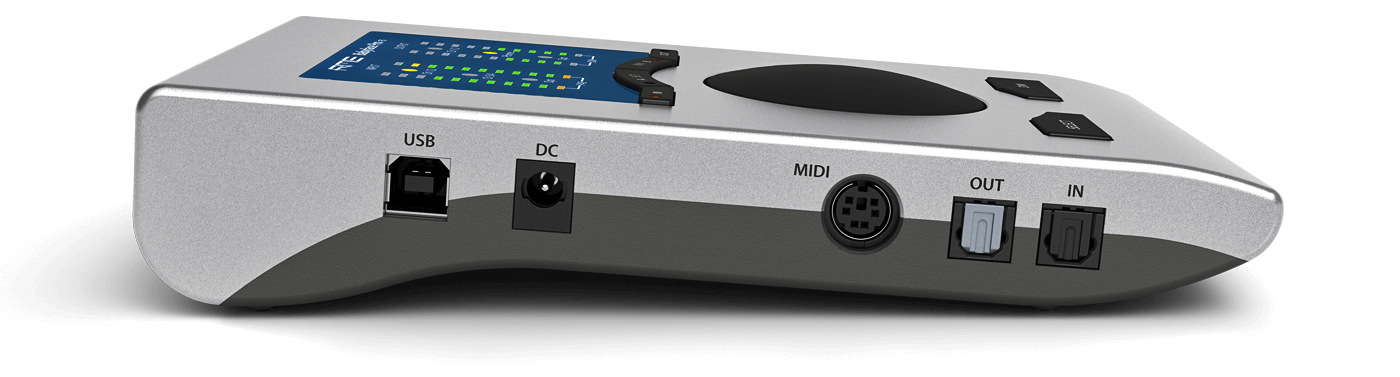
Why USB and not Thunderbolt
in the latest RME audio interfaces?
Because it is dead.
Facts and technological (political) backgrounds:
- Intel never wanted audio interfaces with Thunderbolt. They put up numerous hoops to go through for this not to happen, but several companies (including us) managed to do it.
- Intel declared the TB3 chip that RME wanted to use in an updated UFX+ EOL (End Of Life) last year. All AlpineRidge chips are EOL, the only available one now is the latest TitanRidge 2-port chip, which is no option for us (unclear lifetime, higher current demand, higher costs, higher development effort. Many TB devices stilll available are made from stock of the AlpineRidge chips, so sooner or later many TB audio interfaces will be gone.
- TB4 as in USB4 is much too complicated to add it to an audio interface. Specialized chips that would allow so also don’t exist. And what would it be good for when 99% of the existing audio interfaces don’t even need USB3?
- The Wintel decision to cease support, as dumb as it is, makes clear that Intel sees their interface as a typical computer mass product. After a few years please move on and buy something new… that’s not what we (and many others) like or support.
- Mac OS: The current situation is also quite unique as Mac OS still fully supports TB1, in the latest version and hardware (M2). The reason is that Apple does not use Intel chips anymore, even TB is now made by Apple, so whatever Intel and MS dream of, Apple can do differently. And so far they do. So the UFX+ (and others) still work on that platform via Thunderbolt (TB4 ports with the usual adapters).
- With TB gone as option there only remain PCIe and USB 2/3. And it doesn’t look like that will change in the forseeable future.
- All RME USB interfaces are based on OWN highly effective USB-in-FPGA modelling and outperform all other solutions on the market with lower latency, higher stability and provide a PCIe (TB) comparable performance even on legacy USB2 ports. This is real magic! USB3 has NO speed or stability advantage to USB2 (Made by RME) – it simply provides a higher channel count (MADI I/O!). USB2 works on ALL ports, on all old and new and upcoming computers around the world – PC or Mac. Faster, ultra-stable and with constant high-quality driver updates.